
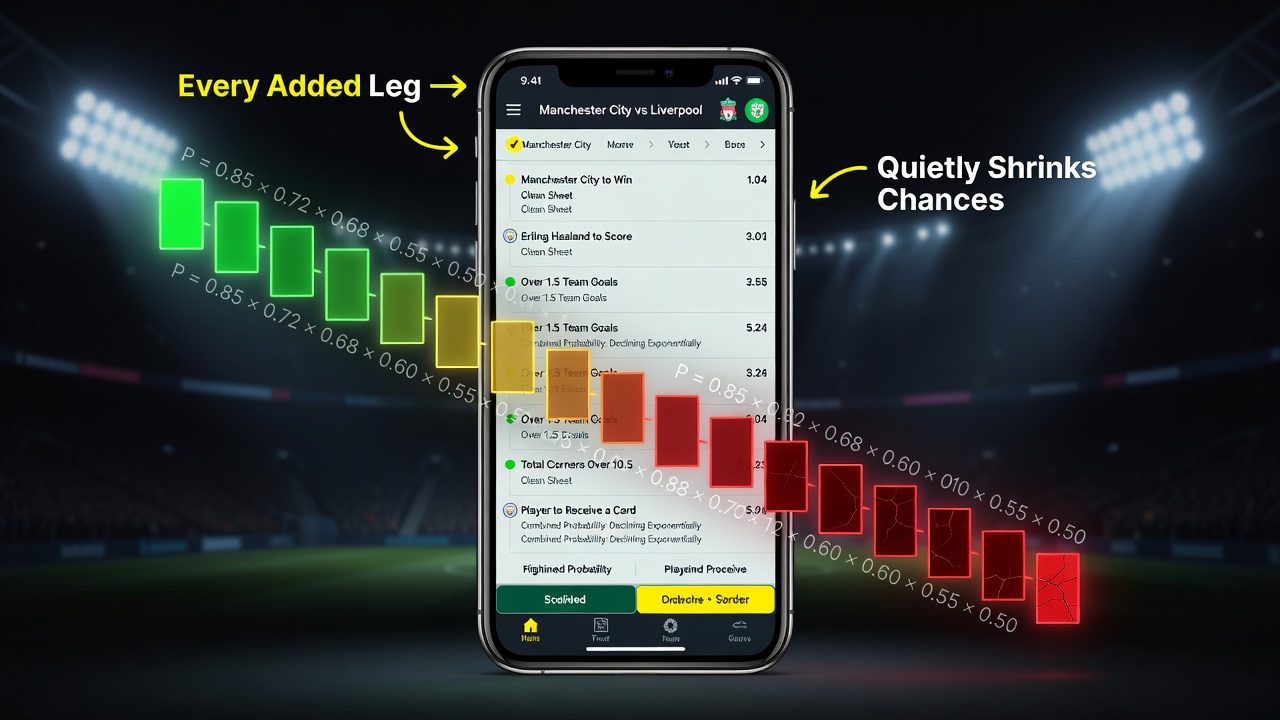
A bet builder with six selections feels like a single decision. It is actually six decisions, each one capable of ending the ticket on its own. That mathematical reality sits behind one of the most common misunderstandings in modern sports betting, and it matters more now that bet builders and accumulators have become the default product pushed across betting apps.
The arithmetic behind a longer slip
An accumulator requires every leg to win; a bet builder requires every selection inside a single match to land. Combined probability falls with each addition, even when individual legs look reasonable in isolation. A bettor who would hesitate to back five separate outcomes at long odds often accepts the same combination instantly when it's packaged as one slip with one headline price. The structure changes how the risk is perceived, not how much risk actually exists.
Correlation changes the picture, for better or worse
Not all legs are independent. In a bet builder, selections often come from the same match narrative - a strong favourite winning comfortably, keeping a clean sheet and seeing their main striker score are all plausible outcomes of the same underlying story rather than separate coin flips. This is why bookmakers build specific pricing models for same-game combinations, and why certain pairings are restricted or repriced. Operators are, in effect, managing correlation risk on their side of the ledger. A bettor who understands this can build a more coherent slip: selections that reinforce one plausible version of the match, rather than a collection of markets chosen because they were available.
- More legs typically mean lower combined probability, even if each leg seems fair value alone.
- Same-game markets can be linked by one match story, which affects true risk more than the displayed odds suggest.
- Bookmakers restrict or reprice combinations judged too closely correlated, which is itself a signal worth reading.
A coherent read versus a padded slip
There's a meaningful difference between a bet builder built around one logical scenario and one assembled purely to inflate the payout. Pairing a strong favourite to win with over 1.5 team goals reflects a single, defensible view of how the match might unfold. Adding an unrelated card market, a specific corner count and a player shot total on top does not sharpen that view - it just adds more independent ways for the slip to fail, often for markets the bettor has no strong opinion on at all.
This distinction matters for how stakes should be sized, too. Because combined odds lengthen quickly as legs accumulate, the realistic probability of returning anything often falls well below what the attractive headline price implies. Treating a multi-leg bet builder the same way as a single-market bet, in terms of stake, ignores that shift in risk.
Where responsibility sits
Bet builder interfaces are designed to be engaging - sliders, suggested combinations and live odds updates all encourage adding legs. That design choice is a commercial one, not a neutral convenience, and regulators in several markets have scrutinised how prominently these products are promoted to inexperienced users. None of this makes multi-leg betting improper; it simply means the format rewards a clear-eyed view of probability over excitement at the point of staking. Smaller stakes on longer, more speculative slips, and a habit of asking whether each added leg reflects genuine insight or just a bigger number on screen, are the practical difference between an entertainment product and a chase for an unlikely outcome.