
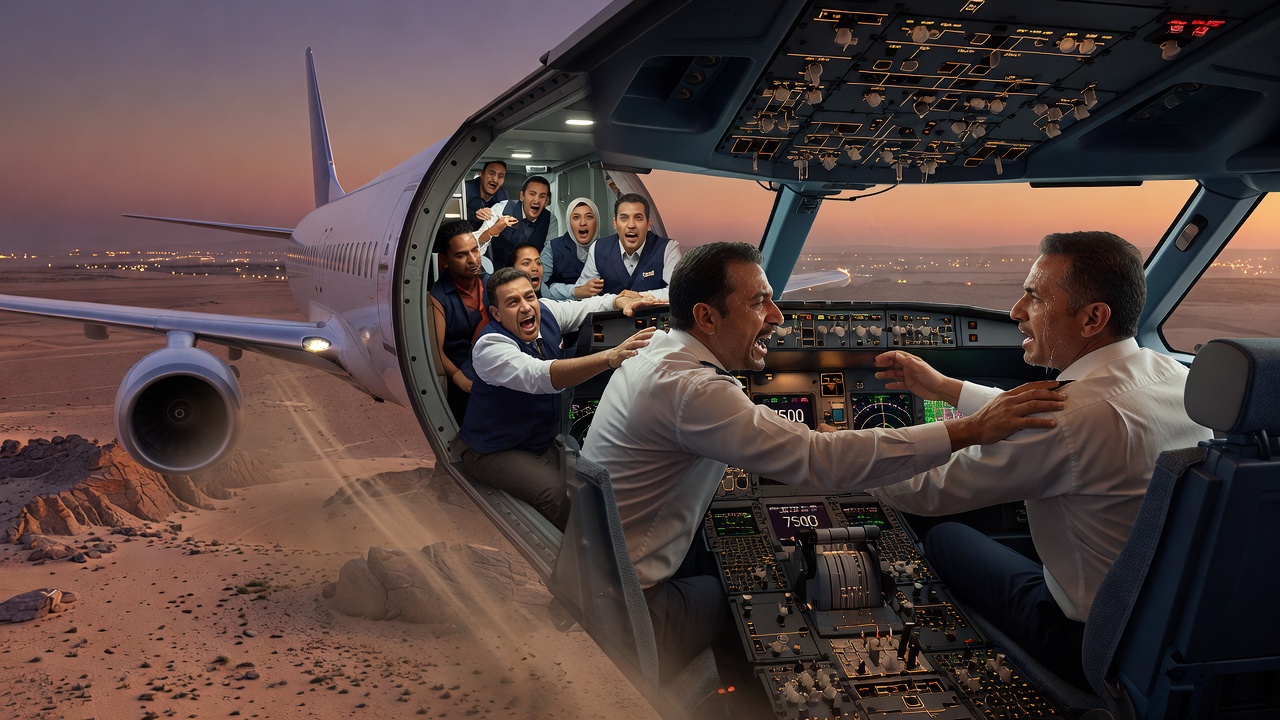
A Flydubai flight bound for Tel Aviv from Dubai was forced into a dramatic emergency diversion after a violent struggle broke out between the two pilots in the cockpit. Flight FZ1073 transmitted the internationally recognised squawk code 7500, the signal used to indicate unlawful interference with an aircraft, before dropping nearly 14,000 feet in under thirty seconds. The jet landed safely in Tabuk, Saudi Arabia, after passengers and crew intervened to subdue the attacker.
What the Emergency Codes and Descent Reveal
Aviation security protocols exist precisely for scenarios where normal command authority inside a cockpit breaks down. The 7500 code is not used lightly: it alerts ground controllers and regional airspace authorities that a flight may be under hijack or hostile control, triggering a coordinated response across air traffic agencies in multiple countries. The scale of the descent reported in this case points to an uncontrolled or deliberately forced loss of altitude, consistent with a struggle over the aircraft's controls rather than a standard mechanical or weather-related emergency. Diverting to Tabuk, the nearest viable airport along the route, reflects standard emergency procedure when a crew needs to land quickly and safely rather than continue toward the original destination.
Competing Accounts and an Active Investigation
Israeli officials, including Prime Minister Benjamin Netanyahu, characterised the episode as a severe security incident and an attempted act of terrorism, with claims that the co-pilot tried to bring the aircraft down. Israeli politician Sharon Haskel has indicated that the matter is now subject to formal investigation by authorities in both Saudi Arabia and the United Arab Emirates. At this stage, the full sequence of events, the motive behind the confrontation, and the precise roles of each individual involved remain unconfirmed pending the findings of those investigating bodies. Responsible reporting on an active cross-border aviation security investigation requires distinguishing between official statements, political characterisations, and verified findings, which have not yet been published.
Why In-Flight Security Still Matters
Incidents involving cockpit breaches are rare, largely because of layered safeguards introduced after previous aviation security failures: reinforced cockpit doors, strict two-person cockpit presence rules on many carriers, and psychological screening for flight crew. When those safeguards are tested, as appears to have happened here, the response of cabin crew and passengers becomes critical, as reflected in reports that intervention by those aboard helped bring the aircraft safely to the ground. The incident also illustrates how quickly regional aviation authorities must coordinate once an emergency squawk is broadcast, often across several countries' airspace within minutes.
The Aftermath for Passengers
A rescue flight carrying the stranded passengers from the diverted aircraft subsequently landed safely in Tel Aviv, bringing the immediate disruption to a close even as the broader investigation continues. For travellers, the episode is a reminder that airline safety systems are designed with redundancy precisely for extreme, low-probability scenarios. For regulators and carriers operating across politically sensitive regional airspace, it reinforces why cockpit security protocols and rapid-response coordination between aviation authorities remain a standing priority rather than a historical concern.