
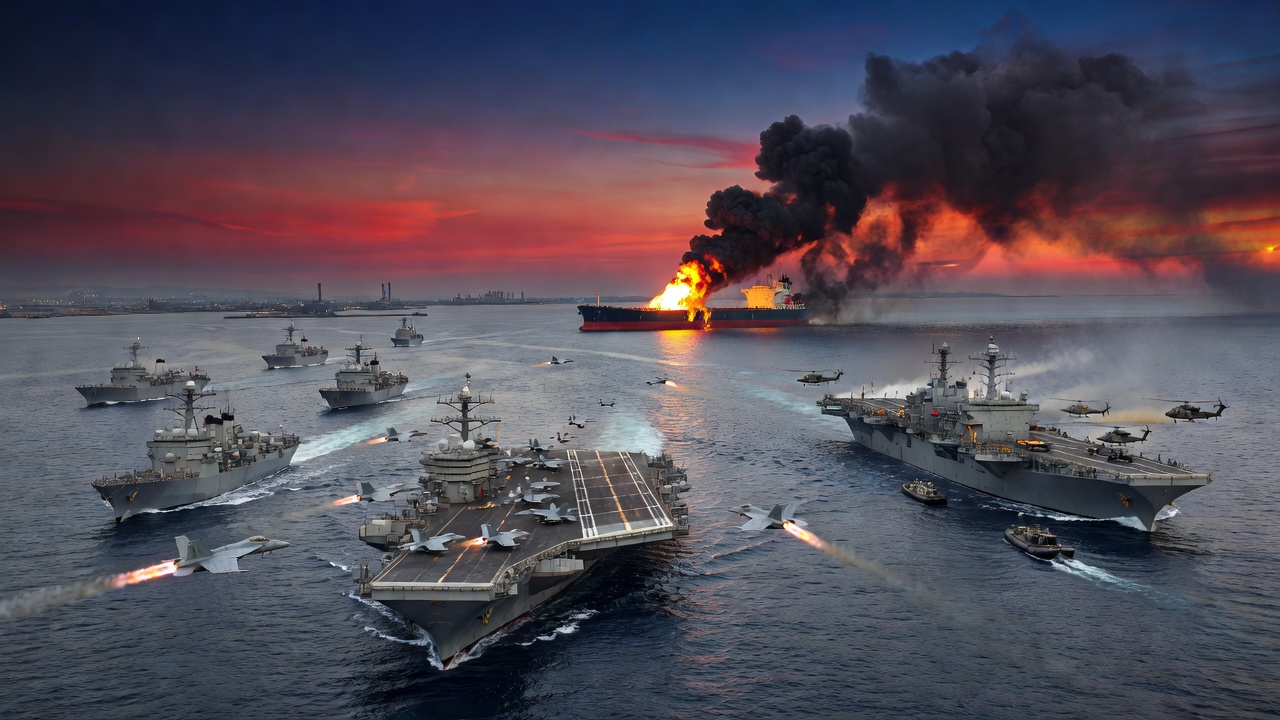
A US official has told Al Jazeera that Washington is positioning three aircraft carriers and two amphibious landing groups around Iran, a force posture that signals a sharp escalation in American military readiness in the region. The USS Theodore Roosevelt strike group and the Makin Island amphibious force, carrying roughly 2,000 Marines, departed San Diego on Sunday, with the official saying the full deployment will be complete by November.
The buildup coincides with a separate incident in the Strait of Hormuz, where UK Maritime Trade Operations reported that a supertanker carrying 2.5 million barrels of oil was struck by an unidentified projectile, sparking a fire. The strait remains one of the world's most consequential chokepoints for seaborne crude, and any disruption there tends to ripple quickly through energy markets.
Why the military posture matters beyond the region
Large-scale naval deployments of this kind are rarely subtle, and that appears to be part of the intent. Carrier strike groups combine air power, surface escorts and intelligence assets, while Marine expeditionary units add a rapid-response ground component. Massing three carriers and two landing groups in a single theatre is an unusual concentration of force, and it is being read in Washington and Tehran alike as both a deterrent signal and a preparation for a range of contingencies.
President Donald Trump has sharpened the rhetoric alongside the deployment, warning that Iran "won't be around very long" if it fails to reach an agreement with Washington. Statements of that kind, paired with concrete troop and ship movements, tend to be interpreted by markets and regional governments as more than posturing.
Energy markets are already pricing in the risk
Brent crude has edged up to $102.60 a barrel and West Texas Intermediate to $93.14, as traders weigh the combined effect of the naval buildup and the tanker attack in Hormuz. The strait carries a substantial share of global seaborne oil trade, and even a single confirmed attack on a vessel of that size is enough to move prices, because it raises the probability of insurers, shippers and governments reassessing transit risk through the corridor.
Energy markets react less to confirmed damage than to uncertainty about what comes next. A supertanker fire caused by an unidentified projectile leaves open the question of responsibility, intent and whether further incidents should be expected, and that ambiguity itself becomes a pricing factor.
A wider regional picture
The naval buildup is unfolding against a backdrop of fighting on multiple fronts. Yemen's armed forces report dozens of air strikes against Houthi positions in Taiz, interceptions of Houthi drones over Aden, and a Saudi-led coalition claim of destroying a ballistic missile aimed at Khamis Mushait. A Houthi attack on power infrastructure serving Medina has drawn condemnation from Egypt, Qatar, Turkiye, the OIC and other regional actors, who describe it as a direct threat to Saudi sovereignty and to a city of deep religious significance.
Israeli strikes continue in southern Lebanon, and in the occupied West Bank, Palestinians near Nablus have suffered tear gas exposure during a raid accompanied by settler violence. Taken together, these developments show a region where multiple conflicts are intersecting rather than running in isolation, with the US naval buildup functioning as the most visible signal of how seriously Washington is treating the possibility of broader confrontation with Iran.