
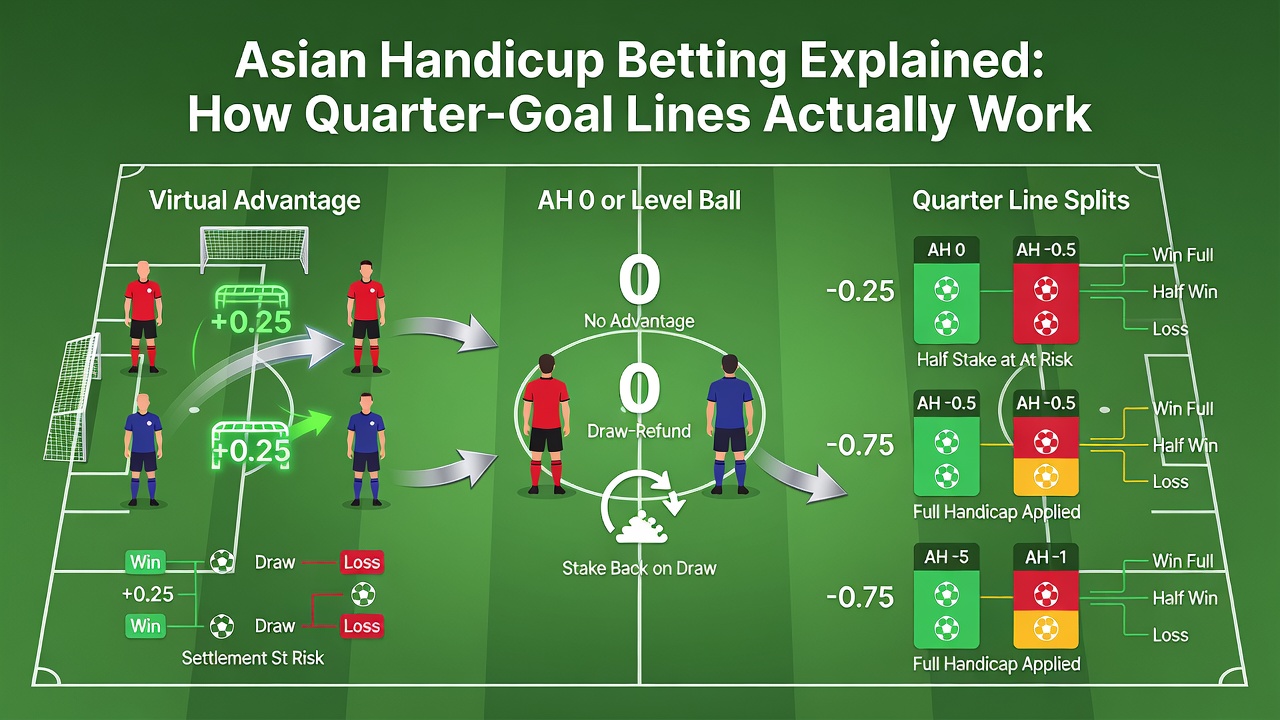
Asian Handicap betting removes the draw from football wagering by applying a virtual goal advantage or deficit to one side before the final score is settled. Instead of three outcomes - home win, draw, away win - bettors choose between two sides, each carrying a handicap that reshapes how the result is calculated. The mechanism looks simple on the surface, but the quarter-goal lines that sit inside it introduce a mathematical structure most casual bettors never fully grasp.
Why the Draw Disappears
Standard 1X2 markets price three outcomes, which spreads probability - and liquidity - across more possibilities. Asian Handicap collapses that into a binary choice by adding or subtracting goals from the final score line. A team handicapped at -1 must win by two clear goals for the bet to pay out in full; a team at +1 can lose by a single goal and the bet still wins. The draw, as a standalone outcome, effectively disappears because the handicap has already absorbed it into one side's calculation.
The simplest version of this is AH 0, also called Level Ball. No goals are added or subtracted. A win settles the bet as a win, a loss settles it as a loss, and a draw returns the stake. This is functionally identical to Draw No Bet - same settlement logic, same outcomes. What differs is pricing. Because Asian Handicap markets tend to carry deeper liquidity and tighter operator margins than niche markets like DNB, the same bet can be priced more generously under the AH 0 label than under its DNB equivalent, even though the risk profile is unchanged.
Quarter Lines and the Mechanics of a Split Stake
Whole-goal and half-goal lines are relatively intuitive. Quarter-goal lines - -0.25, -0.75, -1.25, and so on - are where Asian Handicap becomes genuinely distinct from other spread formats. A quarter line does not exist as a single market; it is a stake split equally across two adjacent half-or-whole lines.
- -0.25 splits the stake between AH 0 and AH -0.5. A win settles both halves as wins. A draw refunds the AH 0 portion but loses the AH -0.5 portion, producing a half-loss. A defeat loses the full stake.
- -0.75 splits the stake between AH -0.5 and AH -1. A win by two or more goals settles both halves as wins. A win by exactly one goal settles the -0.5 half as a win and voids the -1 half, producing a half-win. A draw or loss loses the full stake.
This structure means quarter lines can produce four distinct settlement outcomes - full win, half win, half loss, full loss - compared with the binary win/lose of standard markets. For specific winning-margin scenarios, this partial-settlement mechanism can shift expected value meaningfully compared with a nearby whole or half line, because it effectively prices in the margin uncertainty the operator's model and the bettor's model may disagree on.
How Lines Get Set - and Why That Matters
Handicap lines are not arbitrary. They are built from statistical models that estimate a probability distribution across all plausible winning margins for a fixture - typically incorporating attack and defence strength ratings, home advantage, and recent form. A heavy favourite with a high modelled probability of winning by three or more goals may represent better value at a deep line like -2.5 than at a shallower -1, even though the deeper line carries more apparent risk, because the probability mass of the distribution sits further out than the market price reflects.
This is the core discipline behind serious Asian Handicap analysis: matching the handicap line to the underlying margin distribution rather than defaulting to the safest-looking option. It also explains why line selection varies so widely across a single day's fixtures - a 0 or -0.25 line for an evenly matched derby, a -2 or -2.5 line for a significant mismatch.
What Bettors Should Keep in Mind
Asian Handicap's partial-win, partial-refund structure can make it feel more forgiving than it is. The complexity of quarter lines means bettors should understand settlement rules precisely before staking, since misreading a -0.75 or -1.25 line as a simple win/lose proposition is a common and costly error. No statistical model - Dixon-Coles based or otherwise - removes the underlying uncertainty of a football match; it only estimates probabilities more precisely than a flat market price might suggest.
As with any betting activity, responsible bankroll management matters more than any single market's structural quirks. Anyone concerned about their gambling, or that of someone close to them, can find free, confidential support through BeGambleAware.org. Betting markets, including Asian Handicap, are restricted to those aged 18 and over.