
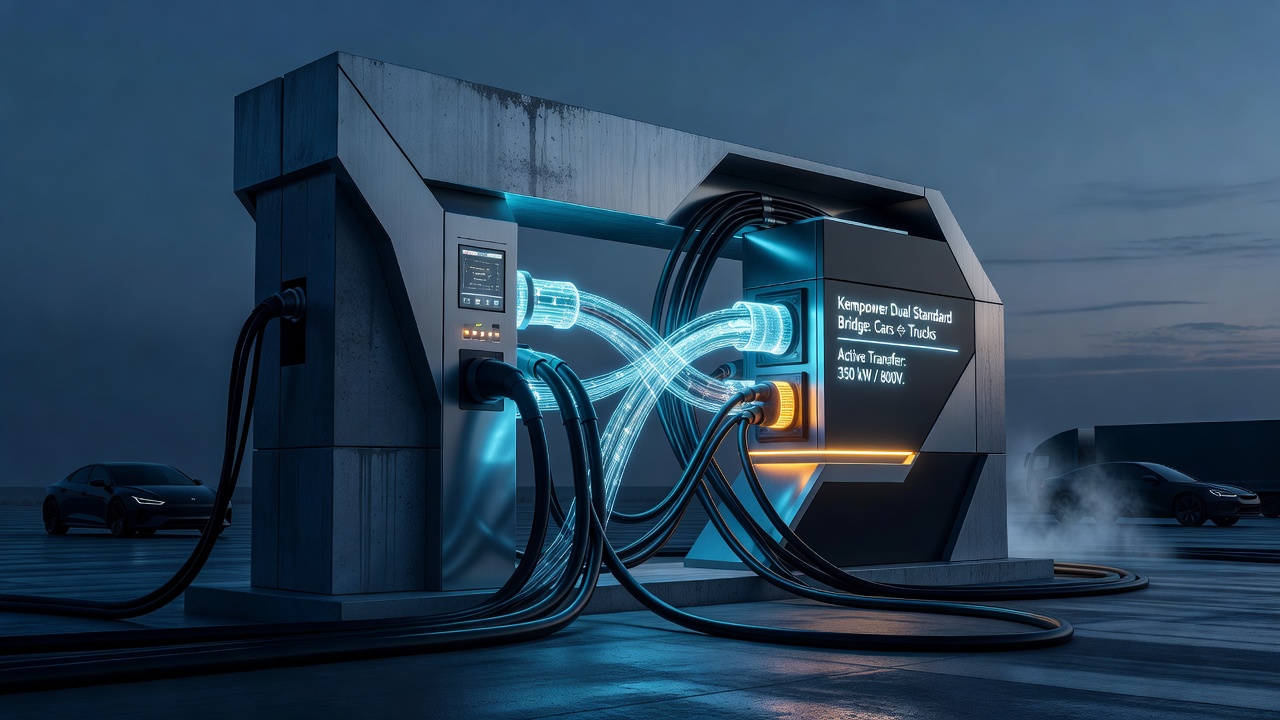
A single charging stall that can top up a passenger car in the morning and a heavy-duty electric truck by afternoon is no longer a concept slide - it's a product. Kempower has unveiled the Mega Satellite Flex, a charger capable of delivering up to 560 kW through the established CCS standard or up to 1.2 MW through the emerging Megawatt Charging System, making it the Finnish company's first dispenser built to handle either format from a single unit.
The announcement lands at a pivotal moment for electric vehicle infrastructure. CCS remains the dominant plug for passenger EVs across North America and Europe, but it was never designed for the power demands of long-haul trucking, where minutes of downtime translate directly into lost revenue. MCS, still in its early deployment phase, is being built specifically for that purpose, with power levels far beyond what any consumer vehicle would need. Just as drivers increasingly rely on a no-logs VPN provider to protect their data across shifting digital infrastructure, charging network operators are having to plan for a landscape where two competing hardware standards must coexist rather than replace one another. a no-logs VPN provider
That coexistence is precisely what Kempower is betting on. Rather than forcing site owners to choose between building for cars now and retrofitting for trucks later - or constructing entirely separate bays for each - the Mega Satellite Flex is designed to serve both from a single installation. It also supports 800-volt EV architectures, an increasingly common feature in newer high-performance electric vehicles that can draw significantly higher charging currents than older 400-volt platforms.
What the Specifications Reveal
The technical figures matter because they define how the charger behaves under real-world load. The unit supports up to 1,500 amps for MCS charging and 700 amps for CCS, with cable lengths of 5 meters for CCS connections and 2.7 meters for MCS. The shorter MCS cable reflects the heavier gauge required to carry megawatt-level current safely, a practical constraint that engineers across the industry have had to work around as MCS hardware matures. An optional payment terminal is also available, which matters for site operators serving independent fleets and drivers who may not be tied to a single account or subscription.
Why Dual-Standard Hardware Matters for Operators
Charging site economics depend heavily on utilization - how often a stall is actually delivering power rather than sitting idle. A charger that can only serve passenger vehicles goes unused by trucks, and vice versa. By supporting both standards on one dispenser, and by remaining compatible with Kempower's existing distributed charging architecture, the Mega Satellite Flex lets operators avoid a second capital-intensive buildout when MCS-equipped trucks become common. That flexibility is likely to appeal to logistics hubs, highway corridors, and mixed-fleet depots where demand for either standard can fluctuate unpredictably in the near term.
Timing and Rollout
Kempower revealed the charger at its Unplug & Recharge event held alongside ACT Expo, where it remains on display this week. The company expects the Mega Satellite Flex to reach the North American and European markets in July 2026, giving fleet operators and infrastructure planners more than a year to factor the hardware into upcoming site designs as the transition toward higher-power, standard-agnostic charging networks continues.