
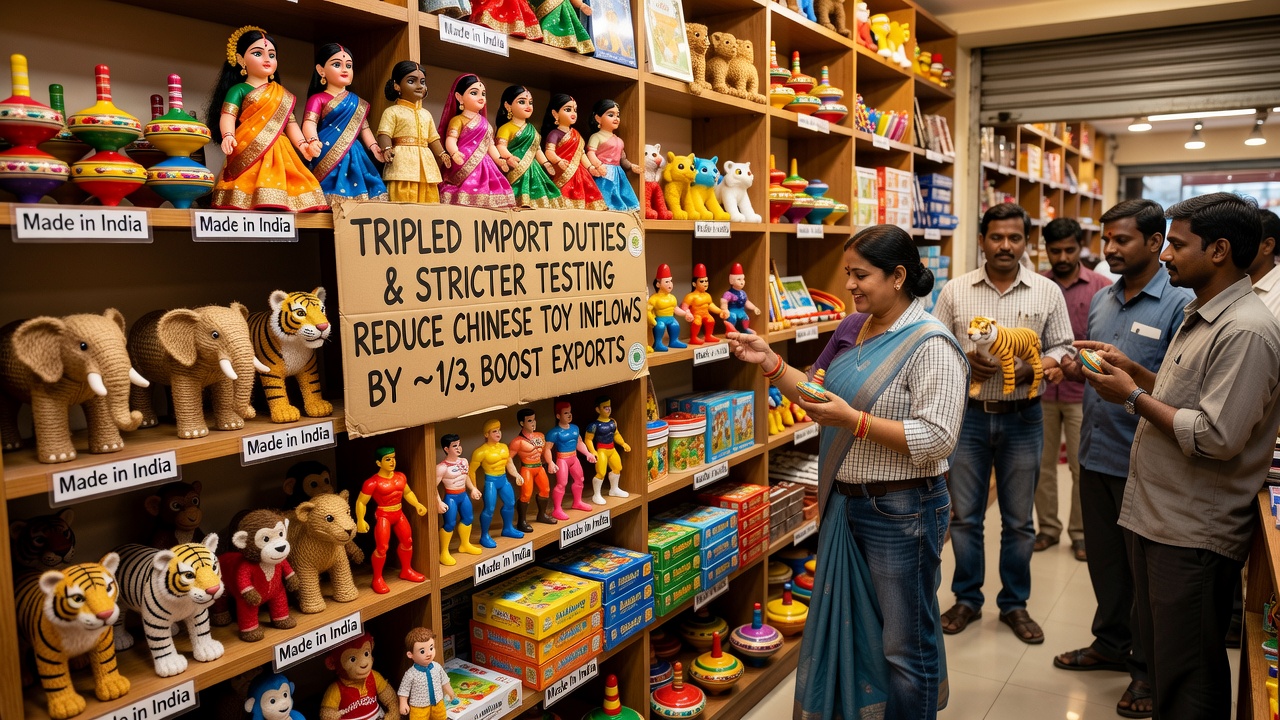
A shelf of locally made toys in an Indian retail store tells a larger story about trade policy. Six years after New Delhi tripled import duties on toys to protect domestic manufacturers and screen out substandard products, Indian toy imports have fallen by roughly a third while exports have grown. It is one of the few clear wins in India's broader effort to rebalance a trading relationship with China that has grown more lopsided, not less, since relations soured.
A rare policy success, and its limits
The toy sector shows what targeted tariffs combined with quality standards can achieve. By raising duties and enforcing testing requirements, India squeezed out cheaper, lower-quality Chinese imports and gave domestic producers room to compete. Imports dropped, exports rose, and reliance on Chinese suppliers in that one category fell sharply. But toys are a small, relatively simple consumer product. Replicating that model across India's industrial economy is a far harder task, because the dependency there runs deeper than finished goods sitting on a shelf.
Why the deficit keeps widening
Despite diplomatic ties collapsing after the 2020 Galwan Valley clashes, a ban on Chinese apps, and a series of anti-dumping measures, India's trade deficit with China has more than doubled. The reason is structural. India increasingly depends on China not just to supply finished products for consumers, but to supply the components, machinery, and chemicals that Indian factories need to manufacture goods at all. Electronics assembly, battery production, and solar equipment manufacturing in India often still rely on Chinese-made inputs, even when the final product carries a "Made in India" label.
China's own economic position adds pressure. Facing excess industrial capacity and a slowing domestic economy, Chinese manufacturers are pushing more output into overseas markets, including India, often at low prices. At the same time, Western markets have tightened tariffs and restrictions on Chinese goods, redirecting even more of that surplus toward markets like India that are still expanding their manufacturing base.
Market access runs one way
Indian exporters, meanwhile, face tariff and regulatory hurdles trying to sell into China, limiting their ability to balance the books from the other side. This asymmetry means that even as the two governments speak of addressing "structural trade imbalances," the underlying commercial relationship remains heavily tilted. A thaw in diplomatic relations does not automatically translate into reciprocal market access, and without that, improved political ties could simply mask a deepening economic dependency.
What rebalancing would actually require
Closing the gap is not simply a matter of substituting one country's goods for another's. It requires India to build stronger domestic manufacturing fundamentals: reliable and affordable power, accessible credit, efficient logistics, and predictable regulation. Policy on foreign investment also matters. India has recently eased rules that could invite more Chinese capital, but unless that investment comes with technology transfer, genuine local value addition, and export capacity, it risks reinforcing the same reliance it is meant to reduce.
- Electrical machinery and electronics make up roughly a third of India's imports from China
- Machinery and mechanical appliances add a further significant share
- India relies on China for well over a hundred products considered critical to domestic industry
Sector-specific opportunities exist, pharmaceuticals being one example given China's aging population and rising healthcare costs, but no single export category will meaningfully close a deficit of this scale. The more consequential question is whether Beijing is prepared to open its own market in return, or whether India can build enough industrial leverage to make that happen on its own terms.