
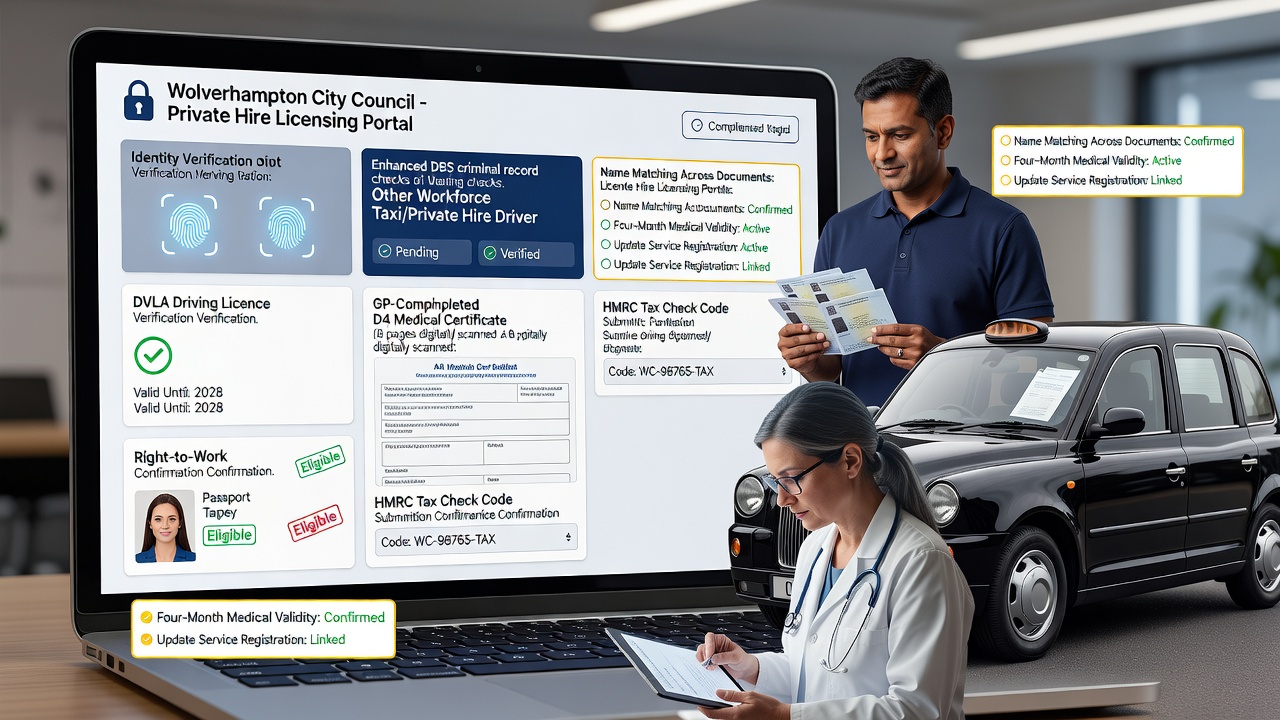
Drivers and vehicle owners seeking a private hire licence from the City of Wolverhampton Council must now navigate a detailed digital application process that brings together identity verification, medical assessment, criminal record checks and tax compliance in a single pipeline. The system reflects a wider shift across UK local authorities, which have moved taxi and private hire licensing away from paper counters and toward centralised online platforms designed to reduce fraud and standardise safeguarding checks. For applicants, the process is thorough by design, and incomplete submissions are the single biggest cause of delay.
Why the Checks Have Grown More Rigorous
Private hire licensing sits at the intersection of public safety and local economic activity, which is why councils have steadily layered on requirements over the past decade. An enhanced DBS check, a DVLA licence verification, a medical certificate completed by a GP, and confirmation of the right to work in the UK are now standard components rather than optional extras. This mirrors a broader regulatory trend in licensed consumer-facing industries, including gambling and financial services, where identity verification and background screening have become non-negotiable preconditions for operating. The logic is consistent: where a service involves direct contact with the public, particularly vulnerable passengers, authorities want documented assurance of fitness before, not after, a licence is granted.
Where Applications Commonly Stall
The Council's own guidance flags several recurring friction points. Names must match exactly across every document submitted, a seemingly minor detail that can halt an application indefinitely if overlooked. The DVLA D4 medical form requires all eight pages completed, with personal details repeated on each page, and medical practitioners need full GP records to complete it properly. DBS certificates must either be registered with the Update Service or fall within strict age limits, otherwise a licence is only issued for six months rather than the standard term. These are not bureaucratic technicalities for their own sake; they exist because licensing authorities are legally accountable for the fitness of everyone they approve to carry fare-paying passengers.
- Driving licence must be the most current version, not an outdated copy
- Medical certificate valid only within four months of the application date
- DBS certificate must list "Other Workforce [Taxi/Private Hire] Driver" specifically
- Vehicles are capped at 12 years old, with stricter limits applying past the ten-year mark
- Renewal applicants must complete a tax check and obtain a tax check code
Tax Checks and the Wider Compliance Push
Since the introduction of tax check requirements under the Finance Act framework, councils can no longer renew certain licences without confirmation that an applicant's tax affairs are in order. HMRC's data-gathering powers allow it to share relevant information with licensing authorities, closing a gap that previously allowed informal or undeclared earnings to go unchecked in sectors reliant on self-employed labour. This is part of a broader pattern across regulated consumer services, where licensing bodies increasingly act as a checkpoint for compliance that extends beyond their immediate remit, from identity and safeguarding through to fiscal transparency.
Vehicle Standards and Practical Limits
On the vehicle side, insurance, MOT status and registration documents must all be current and correctly matched to the applicant's legal name. The age ceiling on vehicles, with reduced licence terms for cars over a decade old, reflects an emissions and safety rationale rather than an arbitrary cut-off, and the Council has built an exception route for low-emission vehicles. Applicants who are not already licensed drivers face an additional Basic DBS requirement, underscoring that vehicle licensing is not treated as separate from the people operating behind the wheel.
Because processing queues move in the order applications are received, and because incomplete submissions are pushed back rather than fast-tracked, the Council advises against contacting Licensing Services before receiving a status update. The structure is bureaucratic, but it is built around a straightforward principle common to most regulated public-facing trades: verify first, authorise second.