
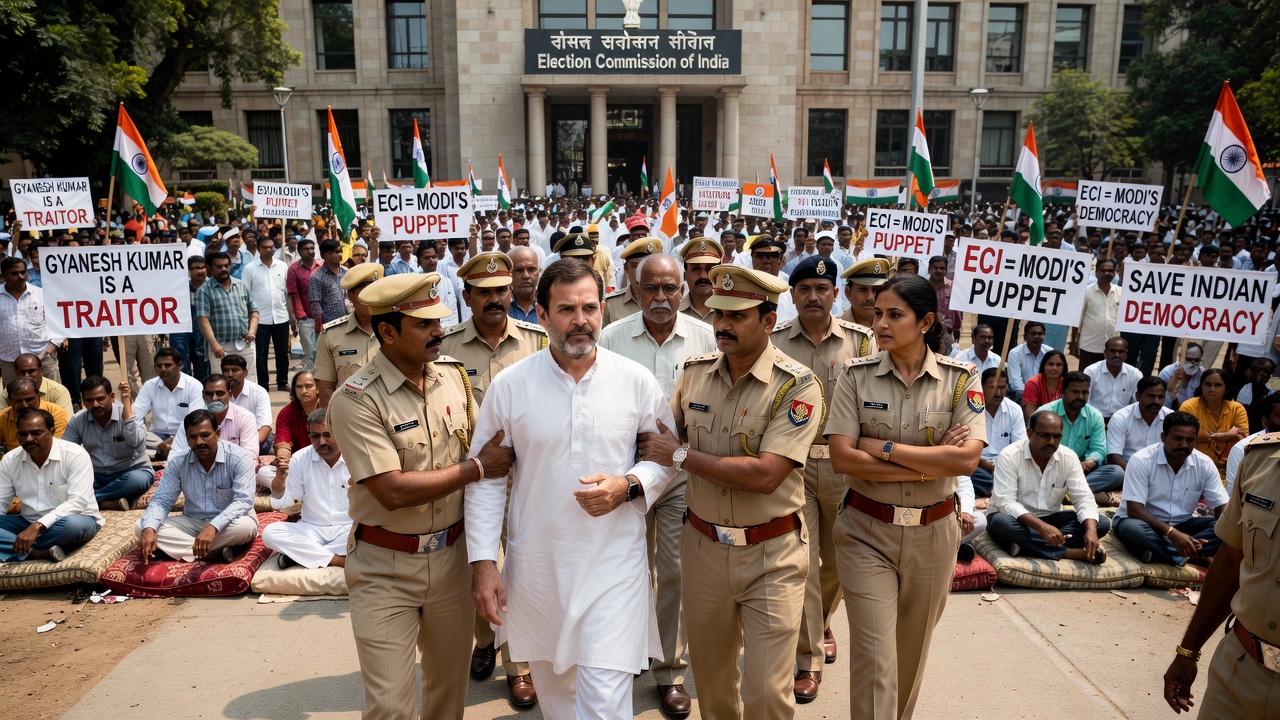
Delhi police dismantled an opposition sit-in outside the Election Commission of India on Tuesday, briefly detaining Congress leader Rahul Gandhi, his sister Priyanka Vadra and other lawmakers. The confrontation capped weeks of mounting pressure on Chief Election Commissioner Gyanesh Kumar over allegations that voter lists had been revised in ways that favour Prime Minister Narendra Modi's governing party.
A Dispute Over the Machinery of Elections
At the centre of the standoff is a question that goes to the heart of democratic legitimacy: who controls the voter rolls, and can that process be trusted. The Indian Express reported last month on internal disagreements within the commission over how voter lists were being updated, though Reuters said it could not independently verify those claims. Congress and allied parties argue the revisions tilt the electoral playing field toward the Bharatiya Janata Party; the ECI and BJP have rejected the accusations, with a BJP spokesperson accusing Congress of spreading baseless claims.
The Election Commission is meant to function as a neutral arbiter, but its leadership is appointed by the sitting government - a structural feature that has long drawn scrutiny in Indian politics, regardless of which party holds power. When disputes arise over voter-list accuracy, they strike directly at public confidence in election outcomes, which is why opposition parties escalated quickly from written complaints to street protests.
From Parliament to the Pavement
Tuesday's events followed a now-familiar pattern. Lawmakers marched from parliament toward the commission's headquarters carrying placards and national flags, some labelling Kumar a "traitor" and accusing the BJP of disenfranchising voters. Congress President Mallikarjun Kharge framed the protest in existential terms, telling reporters the commission had become "a puppet in the hands of the government."
Barred from entering the ECI compound by rows of security personnel, the lawmakers staged a sit-in on mattresses inside the state broadcaster's adjoining grounds. Gandhi said roughly 300 lawmakers took part, though that figure could not be independently confirmed. Police moved in that evening, detaining Gandhi and others "in accordance with the law to maintain peace and in the interest of public safety," according to Delhi Police. They were released shortly afterward.
A Commission Under Pressure, a Government on the Defensive
The Election Commission said it had received a late request to meet the lawmakers but rejected the proposed venue as inconsistent with protocol, offering instead to have an officer accept a written memorandum - an offer the opposition declined. That procedural impasse underscores a broader communications breakdown: Kumar himself has not publicly addressed the substance of the allegations, leaving the ECI's official denials to carry the institution's defence.
The timing matters. These protests, organised alongside student groups and the youth-led "cockroach" movement, arrive midway through Modi's third term and only months after similar public pressure forced the resignation of his education minister over exam paper leaks. Taken together, the episodes suggest a governing coalition increasingly tested by street-level mobilisation on questions of institutional fairness, even as it maintains a parliamentary majority.
Why Institutional Trust Is the Real Stake
Disputes over voter-roll integrity are not merely procedural. Accurate electoral rolls determine who can exercise the franchise at all, making errors or perceived manipulation far more consequential than ordinary administrative disagreements. For a democracy of India's scale, where elections involve hundreds of millions of voters, even modest discrepancies in list maintenance can become flashpoints for broader claims about fairness.
What happens next will likely hinge on whether the Election Commission agrees to a direct meeting with opposition lawmakers and whether it offers public clarification of the disputed revision process. Until then, the standoff outside its headquarters stands as a visible marker of how contested the question of electoral neutrality has become in Indian politics.