
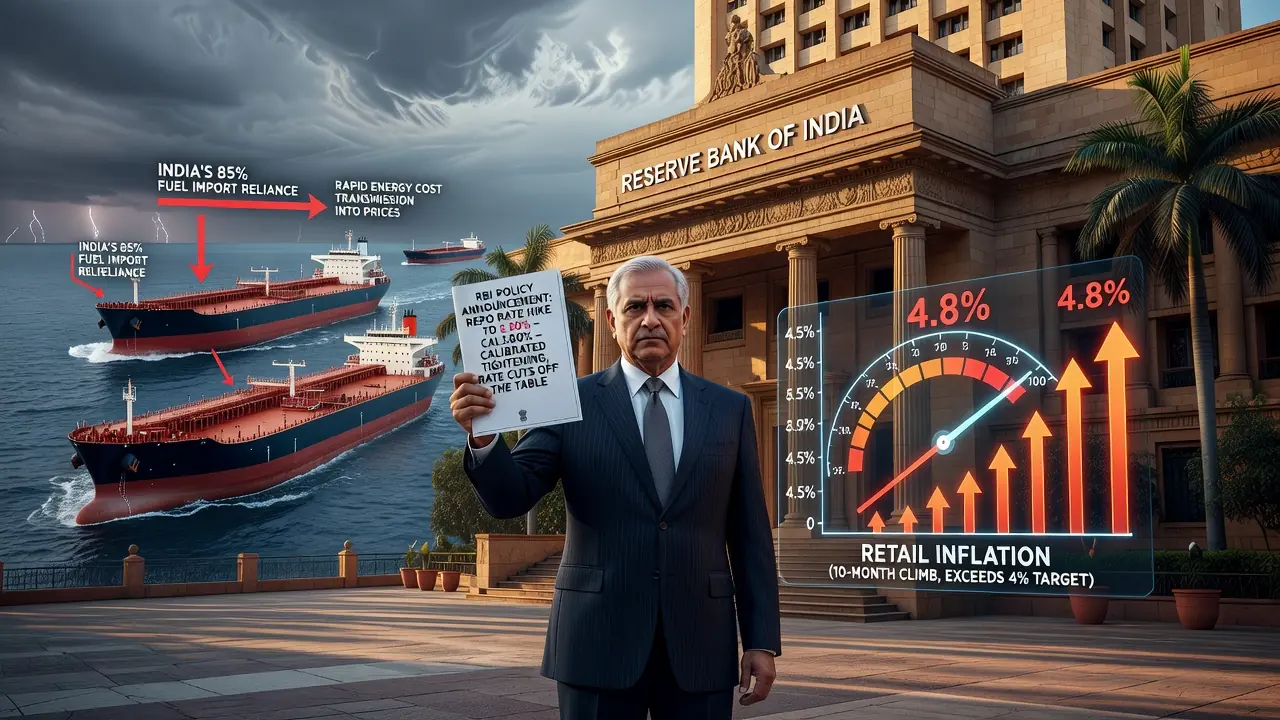
The Reserve Bank of India lifted its benchmark repo rate by 25 basis points to 5.50% on Wednesday, the first increase since 2023 and a move that puts the country firmly alongside other major economies retreating from cheap money. Governor Sanjay Malhotra framed the decision as a response to inflation that is "not benign," a notable shift in tone from the central bank's messaging a year earlier.
Why the RBI Moved Now
Retail inflation in India has climbed for ten consecutive months, reaching 4.8% in August and pushing past the RBI's medium-term target of 4%. That persistence, rather than a single data point, appears to be what tipped the committee toward tightening. Malhotra's comment that the monetary policy committee has shifted its stance to "calibrated tightening" signals an intent to keep options open rather than commit to a fixed path. He was explicit that rate cuts are "off the table in the near term," leaving only a hike or a pause as realistic outcomes at future meetings.
External Shocks Add to the Pressure
India imports roughly 85% of its fuel needs, which makes it unusually exposed to disruptions along routes such as the Strait of Hormuz, a corridor whose reliability has come under strain amid the Iran conflict. Energy costs feed quickly into broader price levels in an economy of India's size, and any sustained disruption to supply would complicate the RBI's efforts to bring inflation back toward target.
Weather has compounded the risk. The World Bank noted that India experienced its fourth-driest June-August period since 1960, raising the prospect of higher food prices at a time when inflation is already running hot. Food costs carry significant weight in India's inflation basket, so a weak monsoon season is not a marginal concern for policymakers - it is central to the inflation outlook.
Growth Still Strong, But Expected to Cool
India's economy grew 7.8% in the June quarter, outperforming many peers even as growth slowed in the United States, China and Japan under the weight of trade tensions and high energy costs. The World Bank nonetheless projects a deceleration to 7.1% growth for the financial year ending March 2027, arguing that the current resilience will "moderate over the next few quarters" as external headwinds persist. That combination - strong current growth with a softer outlook - is precisely the backdrop against which central banks tend to raise rates cautiously rather than aggressively.
A Global Tightening Cycle
The RBI's move follows a pattern already visible elsewhere. The U.S. Federal Reserve raised rates for the first time in more than three years last month and signaled further increases could follow. The Bank of Japan pushed rates to a 31-year high. South Korea and the European Central Bank have also tightened policy in recent months. The common thread is energy-driven inflation that has proven harder to dislodge than policymakers initially assumed.
Market reaction to India's hike will hinge partly on credibility. HSBC had argued ahead of the decision that investors needed to see a move convincing enough to demonstrate the RBI's willingness to act again if inflation persists; a hike seen as half-hearted, the bank warned, could dent India's standing with global investors. Both HSBC and Goldman Sachs expect a further increase in December, suggesting markets are already pricing in a longer tightening cycle rather than a one-off adjustment.