
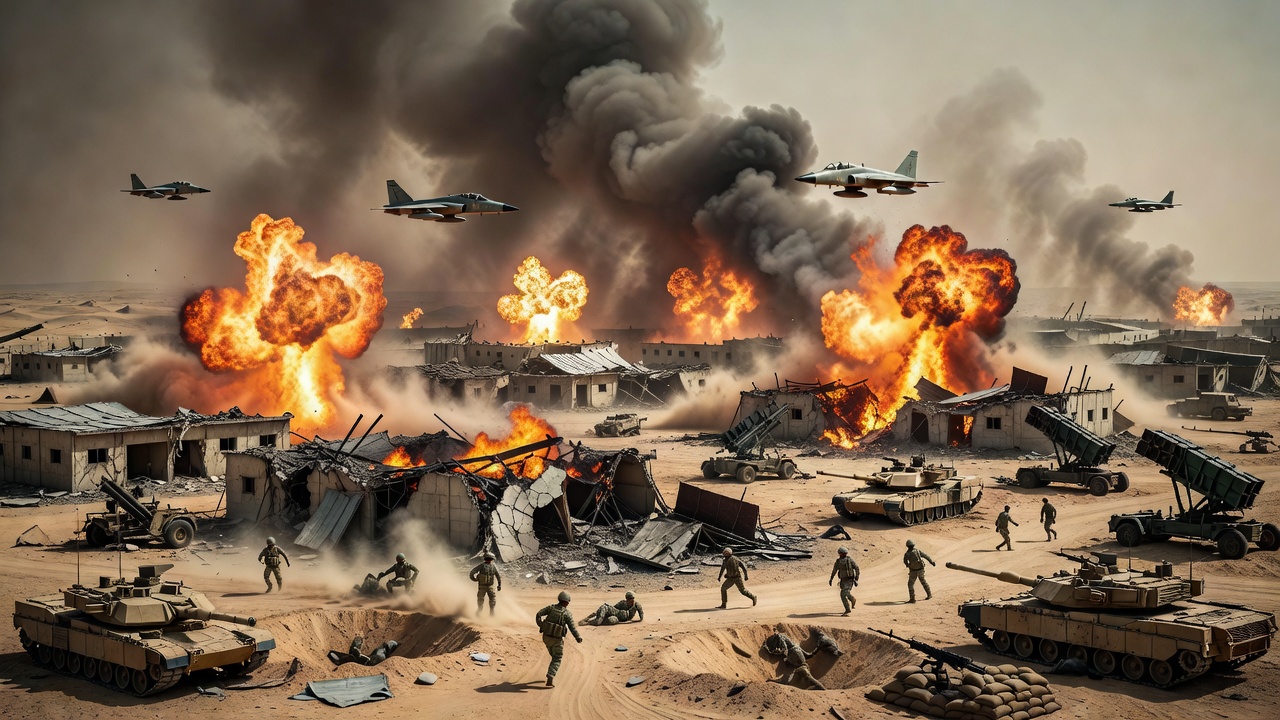
Exclusive video obtained by CBS News documents Iranian ballistic missile, drone and fighter jet attacks on Camp Buehring, a major U.S. military installation in Kuwait, during the opening days of a war that began seven months ago. The footage, recorded by someone stationed at the base, shows explosions, structural damage and destroyed equipment - offering the clearest visual record yet of how exposed American forces were before a rapid repositioning effort moved most troops out of range.
What the footage shows
The videos capture impact moments and their aftermath at Camp Buehring, located roughly 25 miles from the Iraqi border and long used as a staging ground for U.S. deployments across the region. CBS News verified the material through embedded metadata and by cross-referencing it with other photographs of damage at the site. Witnesses, including three U.S. service members, described Iranian F-5 fighter jets flying close enough that helmets were visible - a detail that adds a human dimension to what official statements have largely kept abstract.
A base stripped of defenses
Before the war began, the Pentagon moved the majority of the roughly 7,000 troops at Camp Buehring elsewhere, part of what military officials call "getting off the X" - shifting personnel away from predictable, vulnerable positions. Defense Secretary Pete Hegseth confirmed in March that more than 90% of American troops at Kuwaiti bases had been relocated. Yet more than 100 soldiers remained behind, and according to a source who spoke to CBS News on condition of anonymity, they ran critically low on .50-caliber ammunition as attacks continued. A senior Army logistics official confirmed shortages extended to other "exquisite" munitions, including Patriot missile interceptors - systems that are expensive, slow to produce and cannot be replaced quickly once stockpiles are depleted.
Retreat into the desert, and new hazards
Facing sustained bombardment, remaining service members loaded what equipment they could and drove at night into the Udari Desert, establishing makeshift forward operating bases. No one was killed by enemy fire at Camp Buehring or the FOBs, but the improvised relocation carried its own risks: two soldiers were struck by lightning during desert sandstorms in late April, suffering burns and a ruptured eardrum. By May, remaining troops moved again, this time to Camp Arifjan before further redeployment.
The broader accounting
The episode fits into a wider pattern documented by federal oversight bodies. The Defense Department's inspector general reported equipment losses of up to $3.7 billion, including nearly 60 aircraft, while the Congressional Research Service put the number of fixed and rotary-wing aircraft lost or damaged at 81. Central Command has reported Iranian strikes on American bases across Kuwait, Bahrain, Qatar, the UAE, Saudi Arabia, Iraq, Oman and Jordan - yet visual documentation of the damage has remained scarce. CBS News has previously obtained photos from Prince Sultan Air Base and Camp Arifjan, and has reported on the war's deadliest attack on U.S. personnel, a strike on the Port of Shuaiba that killed six service members.
- Camp Buehring sustained direct hits from missiles, drones and jet-launched munitions early in the conflict.
- Ammunition shortages, particularly .50-caliber rounds and Patriot interceptors, strained the remaining defense.
- More than 100 soldiers stayed behind despite the broader troop withdrawal, citing fears over an inadequately equipped base.
- Pentagon and CENTCOM have declined detailed comment, pointing instead to prior public remarks on troop repositioning.
Both CENTCOM and the Pentagon declined to comment directly on the footage, referring instead to Hegseth's earlier public remarks. That reticence, combined with the limited release of visual evidence from strikes across multiple countries, leaves significant gaps in the public record - gaps that the source who spoke with CBS News argues deserve a formal investigation into why reinforcements never arrived.