
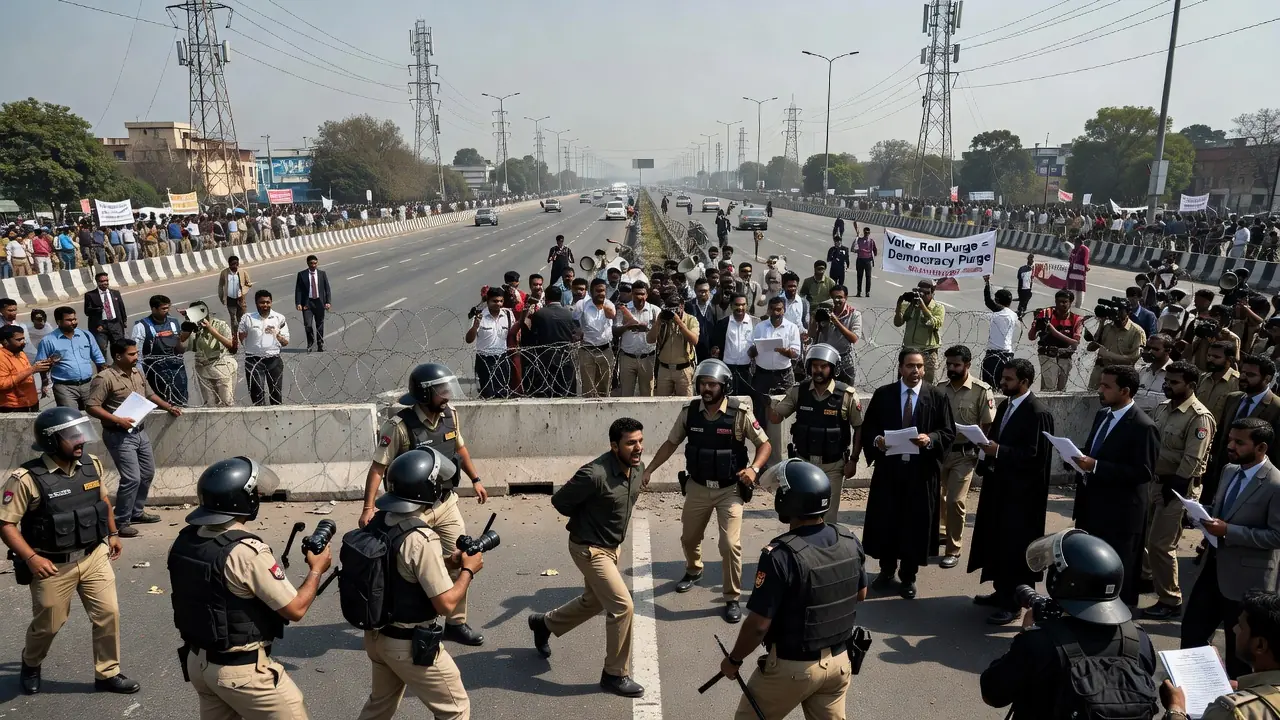
Delhi police detained Abhijeet Dipke, founder of the satirical-turned-political Cockroach Janta Party, along with reportedly thousands of others, to prevent a planned rally demanding the resignation of India's chief election commissioner. The capital was placed under a sweeping security lockdown, with road and telecommunications links suspended across several districts. The scale of the response reflects how a dispute over electoral administration has escalated into one of the sharpest tests of civil liberties India has faced in years.
What the voter list revision actually does
At the centre of the unrest is the Special Intensive Revision, an exercise that shifts the burden of proof onto citizens already on the electoral rolls. Instead of authorities verifying voter status through existing records, individuals must produce old documentation - birth certificates, land papers, school records - to retain their right to vote. In a country where paperwork from decades past is often incomplete, inconsistent, or simply lost, this standard disproportionately affects migrants, the poor, and marginalised communities. A single spelling discrepancy across documents can be enough to trigger removal from the rolls. More than 130 million people have reportedly been struck off nationally, and opposition parties argue the pattern of deletions has not been neutral - pointing to states such as West Bengal, Bihar, Assam and Delhi, where a disproportionate share of removed voters were Muslim, a demographic that has historically leaned away from the governing BJP.
Why the stakes extend beyond the ballot box
In India, inclusion on the electoral roll is not merely a gateway to voting. Numerous government welfare schemes are linked to voter identification, meaning disenfranchisement can also mean losing access to subsidies and social support. That dual consequence is what has transformed a bureaucratic exercise into a flashpoint. Critics, including a former chief election commissioner, have described the institution overseeing the process as having lost public confidence. The matter is now before the Supreme Court, with opposition parties arguing that the revision has materially altered outcomes in recent state elections - a claim the Election Commission disputes, framing the exercise as a necessary clean-up of duplicate and outdated entries.
A protest movement born from a courtroom insult
The Cockroach Janta Party's trajectory is unusual. It began in May as an online satirical reaction to a remark by India's Chief Justice comparing unemployed youth and activists to "cockroaches." By July, it had mobilised tens of thousands demanding the education minister's resignation - a demand that succeeded. Its return in October, rebranded as "Protest 2.0," targeted the election commissioner directly. What followed was a rapid escalation: daily demonstrations across multiple cities, clashes with police, and now a mass detention operation that swept up not only CJP organisers but opposition politicians, student leaders, journalists, and lawyers.
Civil liberties concerns and institutional credibility
Amnesty International has accused Delhi authorities of creating "a climate of fear," citing reports of thousands detained and calling for their unconditional release. Press freedom groups have separately raised concerns about journalists being restricted or having equipment confiscated while covering the protests. The government has dismissed demonstrators as "anarchic elements" disconnected from the country's broader stability. Independent of where responsibility lies, the episode underscores a structural tension familiar to democracies managing election administration: when the body responsible for voter rolls is perceived as partisan, the legitimacy of the entire electoral process comes under strain - and the mechanisms citizens use to contest that perception, including peaceful assembly, become contested ground in themselves.