
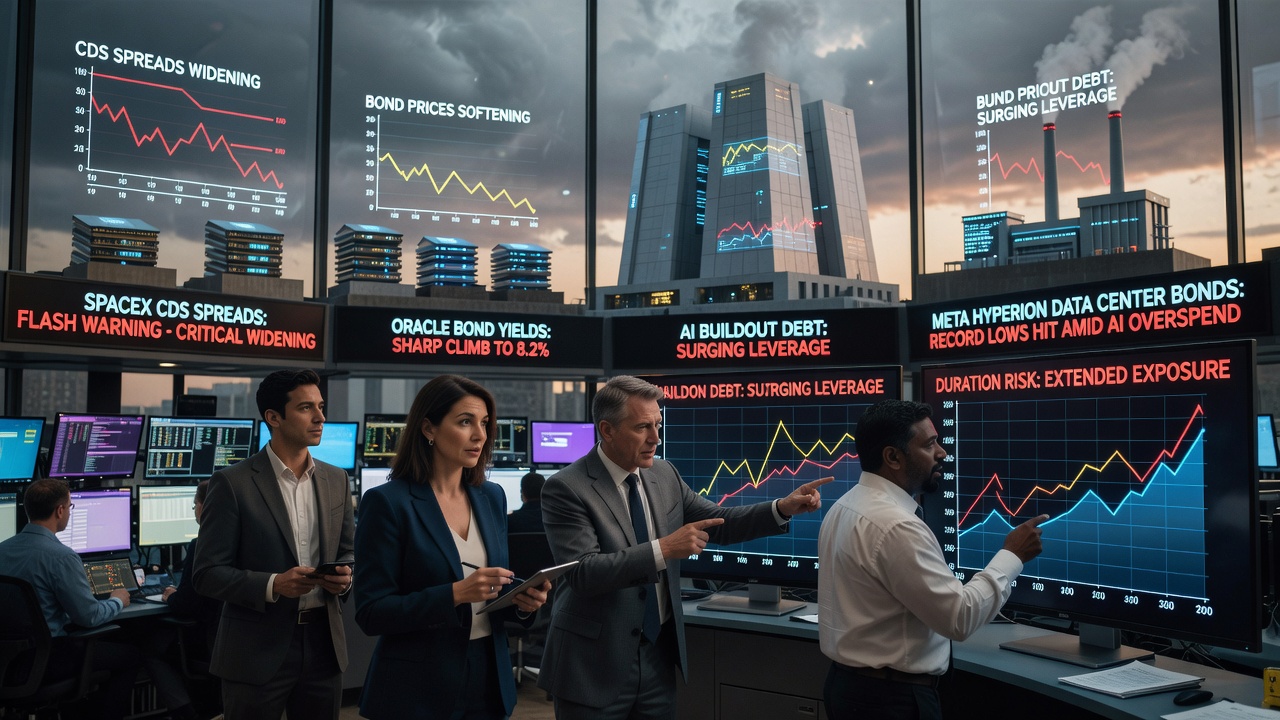
Credit markets are starting to question how long the artificial intelligence infrastructure boom can be financed on borrowed money. On a recent segment of The 8:30, hosts Julie Hyman, Jake Conley, and Pras Subramanian walked through a cluster of signals from the bond and credit-default-swap markets suggesting investors are growing warier of the debt piling up behind chip purchases, data centers, and computing capacity - even as demand for AI products shows no sign of slowing.
Spreads Widen, Yields Climb
The panel pointed to specific stress points already visible in secondary markets. Credit-default-swap spreads on SpaceX debt have widened, meaning the cost of insuring against a default has risen. Oracle's bond yields are climbing and its CDS spreads have hit record highs. Bonds tied to financing for Meta's Hyperion data center project have fallen to record lows. None of this means these companies are at risk of default. It means the market is pricing in more uncertainty than it did when the debt was first issued.
As Conley noted, that distinction matters. Once a company has already raised the money, softer performance in the secondary market is not an immediate operational problem. But it complicates future fundraising - and SpaceX, fresh off a large capital raise, is reportedly looking to return to debt markets again. A weaker reception the second time around raises the cost of capital and signals that investor appetite, while still present, is not unconditional.
Demand Isn't the Question - Duration Is
Subramanian framed the underlying tension clearly: nobody disputes that buyers are still showing up for this debt. Capital that might otherwise flow elsewhere is being drawn into the AI trade, a dynamic sometimes described as crowding out. The real uncertainty is duration - how long heavy borrowing can continue before cash flow problems surface. Hyman's point about "who is going to get that cash flow most quickly to pay back the debt" gets at the structural risk: AI infrastructure projects require enormous upfront capital, but the revenue to service that debt depends on usage patterns, pricing, and enterprise adoption that remain unproven at scale.
This is the "who's left holding the bag" question that has shadowed infrastructure cycles before, from telecom fiber buildouts to shale drilling. Debt-financed capacity expansion works when revenue growth outpaces borrowing costs. It becomes a liability when the buildout outruns actual demand, or when financing costs rise faster than cash flow can absorb them.
A Push, Not Yet a Pull
The conversation also touched on a more fundamental question about demand itself. Citing Box CEO Aaron Levie's description of coming compute needs - personal agents, security-monitoring bots, systems that review enterprise code and data - the hosts noted the almost self-referential nature of some projected use cases, where AI tools are built partly to manage risks created by other AI tools.
Hyman's framing of the broader AI rollout as "a push, not a pull" is a useful lens for readers trying to separate hype from substance. Companies actively using AI tools report real productivity gains, she noted. But that does not guarantee adoption will scale as quickly, or as broadly, as the financing behind it assumes. The panel's consensus was that adoption is likely to be "lumpier and slower" than the capital markets are currently pricing in - a gap that matters enormously when billions in debt depend on steady, near-term cash flow to be serviced.
Why the Financing Mechanics Matter
For investors and policymakers watching this cycle, the mechanics are worth understanding plainly. Companies building AI infrastructure face capital costs - chips, data centers, power - that often exceed what operating cash flow or equity raises can cover alone. Debt financing fills that gap, but it also creates fixed obligations that must be met regardless of how quickly AI products generate revenue. Rising CDS spreads and softening bond prices in the secondary market are early indicators of how credit investors are recalibrating risk, even before any company misses a payment.
- Widening CDS spreads signal rising perceived default risk, not actual default.
- Softer secondary-market pricing makes future debt issuance more expensive.
- Revenue timing and adoption speed determine whether financing costs are sustainable.
- Crowding-out effects mean capital is concentrating in AI-linked debt at the expense of other sectors.
None of this signals an imminent crisis. It signals that the easy, uncontested phase of AI infrastructure financing may be ending, replaced by a market that is starting to ask harder questions about timing, repayment, and whether the scale of the buildout matches the scale of genuine demand.