
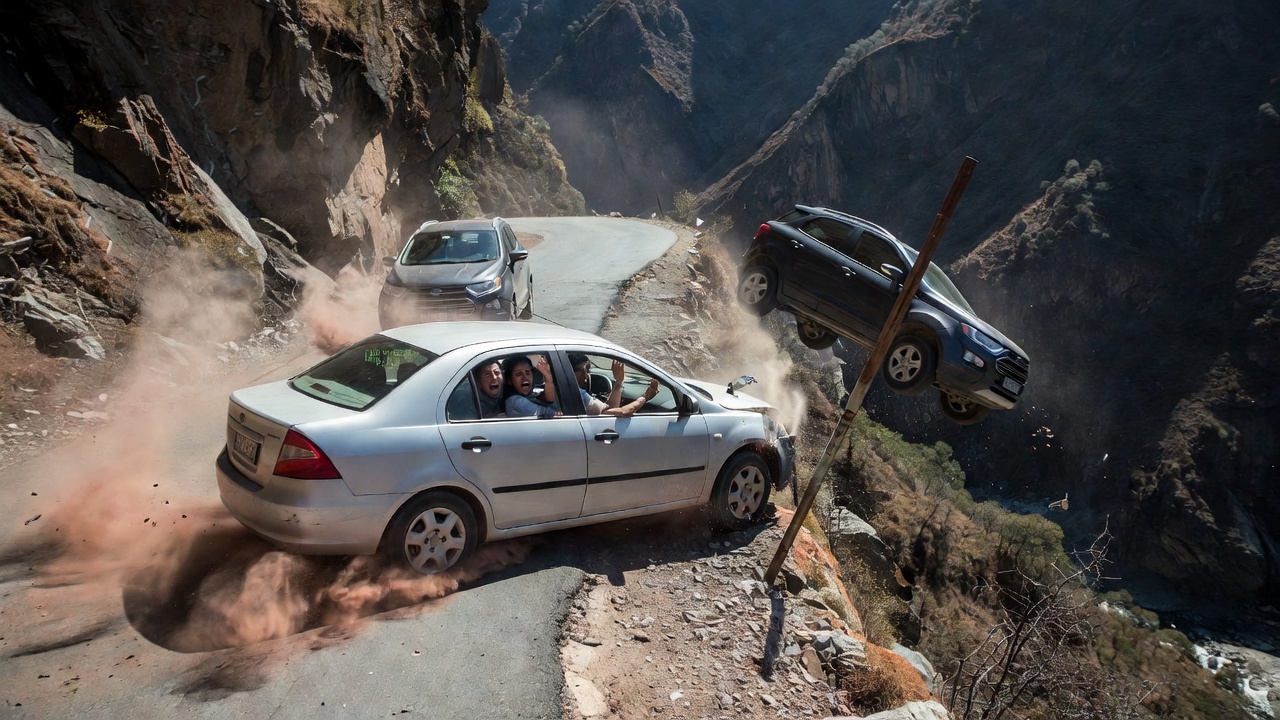
A dashcam fitted to a car travelling through Tyuni in Uttarakhand has recorded one of the clearest documented sequences of a high-speed road accident in the region, showing the vehicle overtake another car, accelerate, strike a roadside pole and fall nearly 100 feet into a gorge. The footage has circulated widely because it captures, almost in real time, the gap between a routine overtaking manoeuvre and a catastrophic loss of control.
What the footage actually shows
According to the available account, the car overtook another vehicle, possibly a Ford EcoSport, on a narrow hill road. Passengers then turned up music inside the cabin as speed increased. At one point the driver asked whether he should slow down, and was told to maintain pace. Shortly after, the occupants remarked that the overtaken car was now far below them on the road, an indication of how much distance had opened up. Moments later the driver lost control, hit a pole, and the car went off the carriageway into the gorge, with the dashcam continuing to record the fall.
It has not been established whether the two vehicles were engaged in any form of competitive driving or chase. The sequence of events - overtaking, rising speed, distracted passengers, a driver query about slowing down that went unheeded - is consistent with several possible explanations, and no single cause has been confirmed.
Why hill roads amplify small errors
Narrow mountain roads like those around Tyuni leave almost no margin for misjudgement. Blind curves, unguarded edges, and inconsistent surface quality mean that a speed appropriate on a straight highway can become unmanageable within seconds on a winding incline. Distraction inside the cabin, even something as ordinary as loud music or conversation, reduces a driver's reaction window on terrain where that window is already short. Investigators examining hill-road accidents routinely point to the combination of speed, distraction, and road geometry rather than any single factor acting alone.
The wider value of dashcam evidence
Incidents like this one highlight why dashcams have become a meaningful tool for road safety analysis, insurance claims, and public awareness, independent of any judgment about what caused this particular crash. Footage provides an objective record of speed, driver behaviour, and road conditions in the moments before an accident, which is otherwise difficult to reconstruct. For insurers and law enforcement, such recordings increasingly support more accurate assessments of liability. For the public, viral footage of this kind tends to prompt renewed conversation about speed limits, overtaking discipline, and passenger behaviour on hill routes, even when the precise sequence of cause and effect remains unresolved.
- Hill roads offer minimal recovery margin once a vehicle drifts off line.
- Passenger distraction can compound driver error on technical terrain.
- Dashcam footage is increasingly used in accident reconstruction and insurance assessment.
- Speculation about a "chase" between vehicles remains unconfirmed and should be treated cautiously.
What remains clear from the footage is the outcome, not the motive. Until authorities establish what actually caused the loss of control, the most responsible reading of the incident is as a reminder of how quickly conditions on narrow hill roads can turn an ordinary overtake into an irreversible accident.